
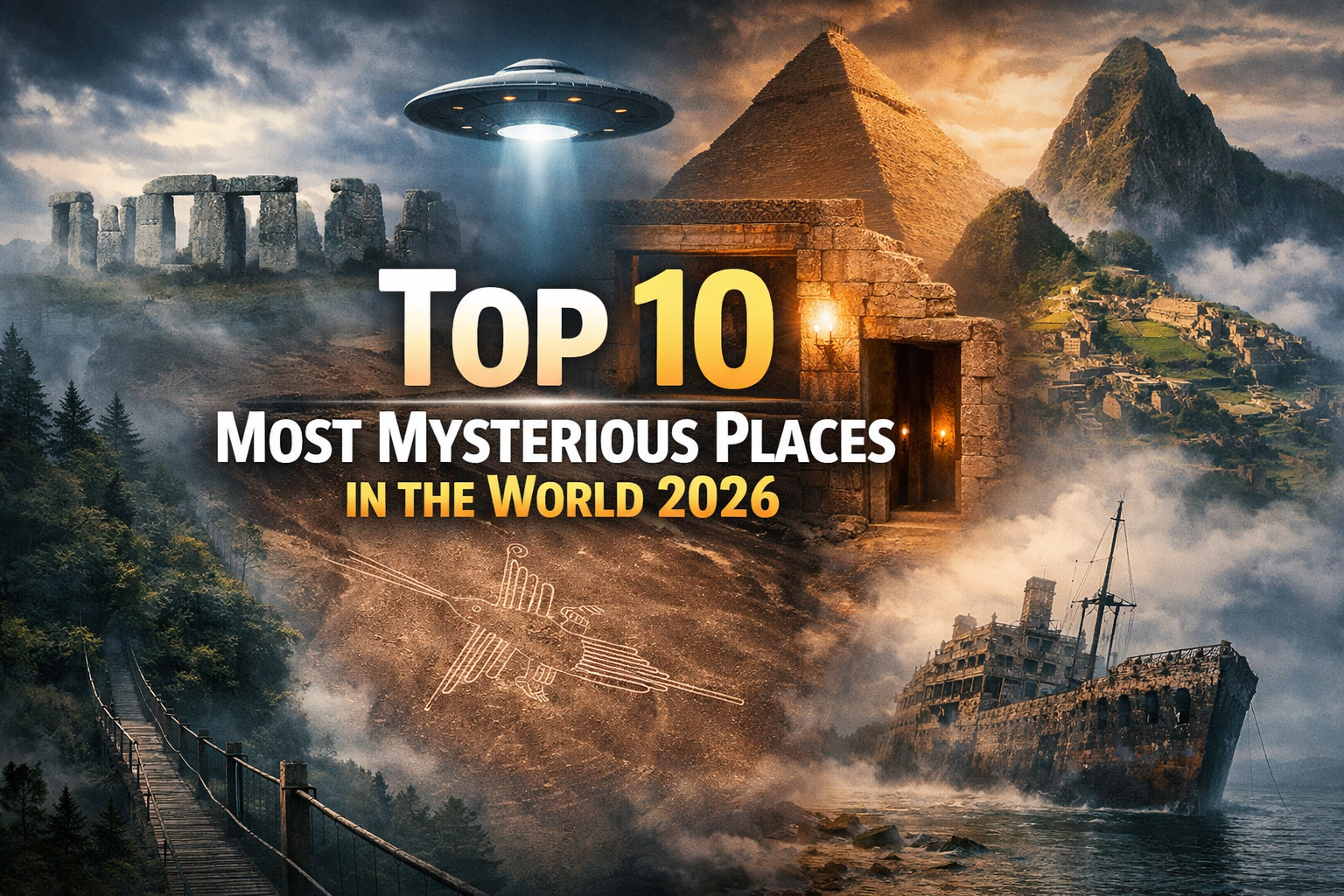
This article explores ten of the most mysterious places in the world you can visit right now. We describe what makes these places feel weird and why they are yet unexplained. The accent is on mystery, mood, and human curiosity.
Why are there so many unsolved questions about Machu Picchu?

Despite being one of the best-known ancient settlements on Earth, we know little about Machu Picchu in Peru. For hundreds of years, the Inca civilization concealed this stone metropolis from the outside world by building it high in the Andes Mountains. The reasons behind its construction and abrupt abandonment remain the subject of debate among historians. While some assume it served a religious purpose, others claim it was a royal retreat. There are no written documents from the Incas to support these theories.
The sophisticated engineering employed without contemporary techniques is what makes Machu Picchu enigmatic. Even now, a sword cannot pass between massive stones because of how firmly they fit together. The city’s alignment with the sun on specific dates indicates a profound understanding of astronomy. Fog often sweeps through the ruins, contributing to the illusion that the site lies between realms. Typically, visitors describe Machu Picchu as a serene, eerie wonder that seems alive with long-forgotten mysteries.
What mysteries do Easter Island and the Nazca Lines hide beneath them?

Ancient people carved the enormous designs known as the Nazca Lines into the desert floor in Peru. They display long, straight lines that extend for miles, as well as the shapes of plants and animals. How the ancient humans made these enormous drawings without being able to see them from above is a mystery. Why anyone created them at all is even more perplexing. While some may relate to water supplies or astronomy, others assume they were used in religious rites.
The enormous stone statues known as Moai on Easter Island, which is in the Pacific Ocean, are another mystery. Some of these monuments weigh more than 80 tons, but they were sculpted and transported by humans using simple tools. Scientists still debate how they moved them across the island. It’s also unclear why the civilization collapsed and what they created. Both locations give visitors the impression that time has claimed antiquity’s information.
In what ways does Stonehenge still baffle contemporary science?

Despite being one of the most studied ancient structures in the world, Stonehenge in England remains incredibly mysterious. Long before there were any sophisticated machines, thousands of years ago, people positioned the enormous stones. People have concerns regarding how ancient people moved some rocks that they hauled more than 150 miles. The amount of work required indicates that Stonehenge was essential to its builders.
Stonehenge’s purpose is still up for debate. Some people say it was a burial site, while others claim ancient peoples used it for seasonal and sun-related ceremonies. As a result of meticulous preparation, the sun rises precisely along the line of the stones on the summer solstice. There isn’t a single explanation that can address every query, even after years of inquiry. The vast sky and the quiet of the rocks provide visitors with a strong sense of mystery.
Why do curiosity and fear surround Area 51?

Located in the Nevada desert of the United States, Area 51 is a highly restricted military installation. Reports of covert tests and extraterrestrial spacecraft have been connected to it for many years. The government recognized its existence only in 2013, which only fueled further conjecture. It’s one of the most hidden locations on Earth, with strict security, warning signs, and no-fly zones.
Many people believe there is more to Area 51, even though officials assert it is used for aviation testing. Reports of odd lights in the sky and UFO encounters still draw attention. Although the base is off-limits to visitors, many go nearby in the hopes of catching something special. Area 51 remains one of the most enigmatic locations due to the lack of concrete information.
Why are Lake Hillier and the Bermuda Triangle so peculiar?

Uncertain circumstances have purportedly caused ships and aircraft to vanish in the Bermuda Triangle, an area of the Atlantic Ocean. Tales of strange lights, unforeseen storms, and compass failures have made this area famous. The belief persists because, despite scientific explanations like weather patterns and human error, many incidents remain unexplainable.
Australia’s Lake Hillier is enigmatic for a different reason. Even from the ground, its vivid pink hue appears surreal. Scientists think that salt levels and microbes are responsible for the color’s year-round consistency. The precise balance that produces this impact is still being investigated, though. It’s like entering a different world when you see a naturally pink lake.
Why do Mount Roraima and the Paris Catacombs seem unreal?

Subterranean caves known as the Catacombs of Paris hold the bones of more than six million people. This black labyrinth, which extends for miles beneath the city, was designed to alleviate overcrowding in cemeteries. Many places restrict access to the general public, and those who unlawfully enter claim they got lost or felt they were being observed. The continuous rows of skulls and the silence create an unsettling mood.
Mount Roraima resembles a flat-topped island in the sky and sits on the boundary between Venezuela, Brazil, and Guyana. It is frequently surrounded by clouds, giving the impression that it is inaccessible. One of the oldest mountains on Earth, it is home to unique vegetation. According to local mythology, it is the stump of a massive tree of life. It is extremely enigmatic due to its remote location and peculiar ecosystem.
What gives the Door to Hell its horrifying moniker?

Since 1971, the Door to Hell, a gas crater in Turkmenistan, has been ablaze. A drilling mishap caused the ground to collapse, forming a crater. Scientists set the toxic gas on fire in the hopes that it would burn out soon and prevent it from spreading. Instead, it has burned for many years.
The desert sky is illuminated by the burning flames at night, producing a surreal image. Nobody is sure when the fire will end or how much gas is still underground. The crater’s unusual location and continuous burning draw travelers from all over the world, making it one of the planet’s most bizarre sights.
Conclusion
We are captivated by mysterious locations because they serve as a reminder of how much we still don’t know. These ten locales, which range from historic stone cities to natural wonders and hidden spots, test our knowledge of science, history, and the natural world. Traveling is only one aspect of visiting them; another is feeling awe, quiet, and unsolved questions. These locations still arouse wonder and curiosity among people all around the world in 2026.
People are inherently inquisitive. Mysterious locations cause us to doubt history and reality. They give people a sense of connection to something greater than themselves and enable them to envision stories beyond ordinary existence.
Not all the time. If you travel carefully, you can safely visit a lot of enigmatic locations. Ignoring regulations, going into prohibited regions, or misinterpreting local conditions are the leading causes of danger.
Although tourism can transform a location, mystery frequently persists. These places remain unique despite the large number of tourists due to unresolved issues and poignant experiences.
Over time, science may be able to explain many things, but other mysteries rely on human beliefs or on lost history. Not everything is totally verifiable or replicable.
Visitors should do their homework and show consideration for the locals.